
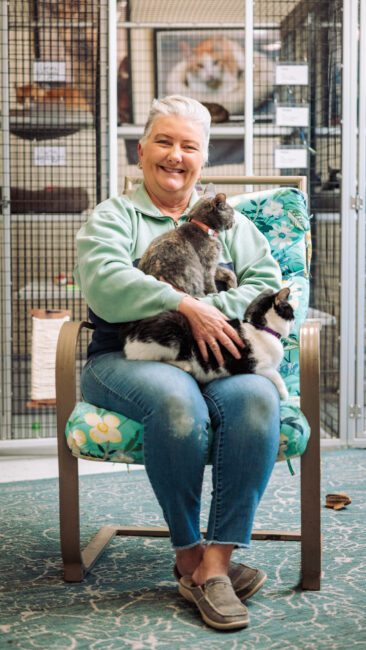
Wander through any part of Las Cruces, and you’re less likely to spot some of the region’s iconic wildlife—coyotes, whiptail lizards, rattlesnakes, and roadrunners—than you are a more common presence: feral (unsocialized) cats, also called community cats. Doña Ana County continues to grapple with the persistent challenge of cat overpopulation.
For some Aggies, seeing a problem in the world sparks a quiet determination to help—even when they know they’ll receive no recognition, no compensation, and the work to solve the problem will take time (lots of it) and effort. Michelle Corella ’87 is one of those Aggies and knows firsthand that good things sometimes take time and effort.
No stranger to hard work
Michelle moved to Las Cruces at age 15 when her mother relocated the family from Deming, NM, following the passing of Michelle’s father at age 41. Michelle had no choice but to work after high school: “I worked full time and went to school when I could. It took me 13 years to first get my associate degree from NMSU in 1987 from the College of Health and Social Services and later a bachelor’s in mathematics from Regents College [now Excelsior University] in 1993.”
At NMSU, Michelle worked as a co-op student with NMSU’s Physical Sciences Laboratory at NASA’s Telemetry Data Relay Satellite System site for three years and then worked at WSMR at the Training and Doctrine Command for five years. She returned to NASA, serving as an IT contractor for eight years before joining NMSU’s Information and Communication Technologies (ICT) department, where she worked until her retirement in 2019.
Michelle has been equally tenacious in her 22-year effort to humanely reduce the number of feral cats on the NMSU campus and in the Las Cruces community. She was awarded NMSU’s J. Paul Taylor Social Justice Award in 2015 for her ongoing commitment to animal welfare.
A nearly purrfect solution
It all started in 2002, when, while working at NMSU’s ICT department, Michelle saw a listserve post about a group forming to address the issue of feral cats on campus. Michelle attended a meeting—and today she is still saving cats.
The group was called the Feral Cat Management Program (FCaMP) and started out with four volunteers. At the time, NMSU groundskeepers were responsible for trapping the approximately 250 cats that roamed campus and taking them to the municipal animal shelter to be euthanized—at taxpayer expense. But this did nothing to reduce the problem.
With the blessing of the NMSU administration, FCaMP replaced euthanasia with a systematic process of trap-neuter-return (TNR): trapping, sterilizing, vaccinating, and microchipping the cats and returning them to where they were trapped to create a no-growth situation. Cats’ ears are tipped to indicate that they have been TNRed so they are not trapped again. FCaMP volunteers also fostered and found homes for more than 100 kittens and tame adult cats abandoned on campus.
Michelle led FCaMP through the process of becoming a 501c3 and was executive director from 2007 until 2017, managing fundraising, the website, public relations, fielding questions, and serving as the liaison with Calista Animal Hospital, where the procedures were done. TNR isn’t free (FCaMP received no funding from NMSU), and Michelle organized yard sales (twice a year for 12 years) and ButterBraid sales to raise money.
FCaMP disbanded when Michelle retired and no one stepped up to take the lead. Fortunately, by then the program had accomplished its primary mission. Under Michelle’s watch, the number of cats on campus declined from the estimated 250 to the 20 or fewer today—a success driven by the end of reproduction and natural attrition, as outdoor cats face many dangers. About eight NMSU staff and faculty members feed and water the remaining cats and keep an eye out for newcomers.
 |
|
 |
Furrever faithful to felines
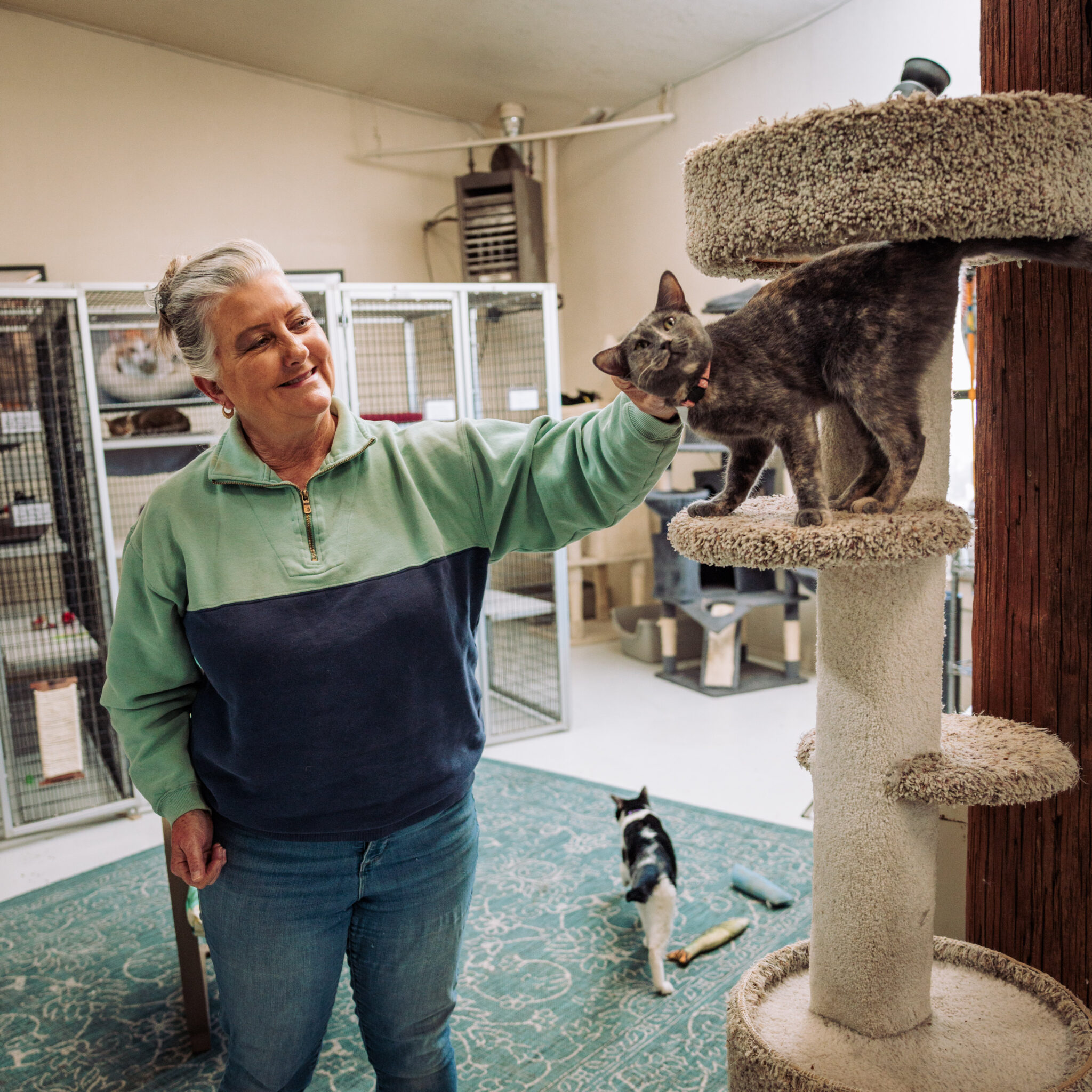
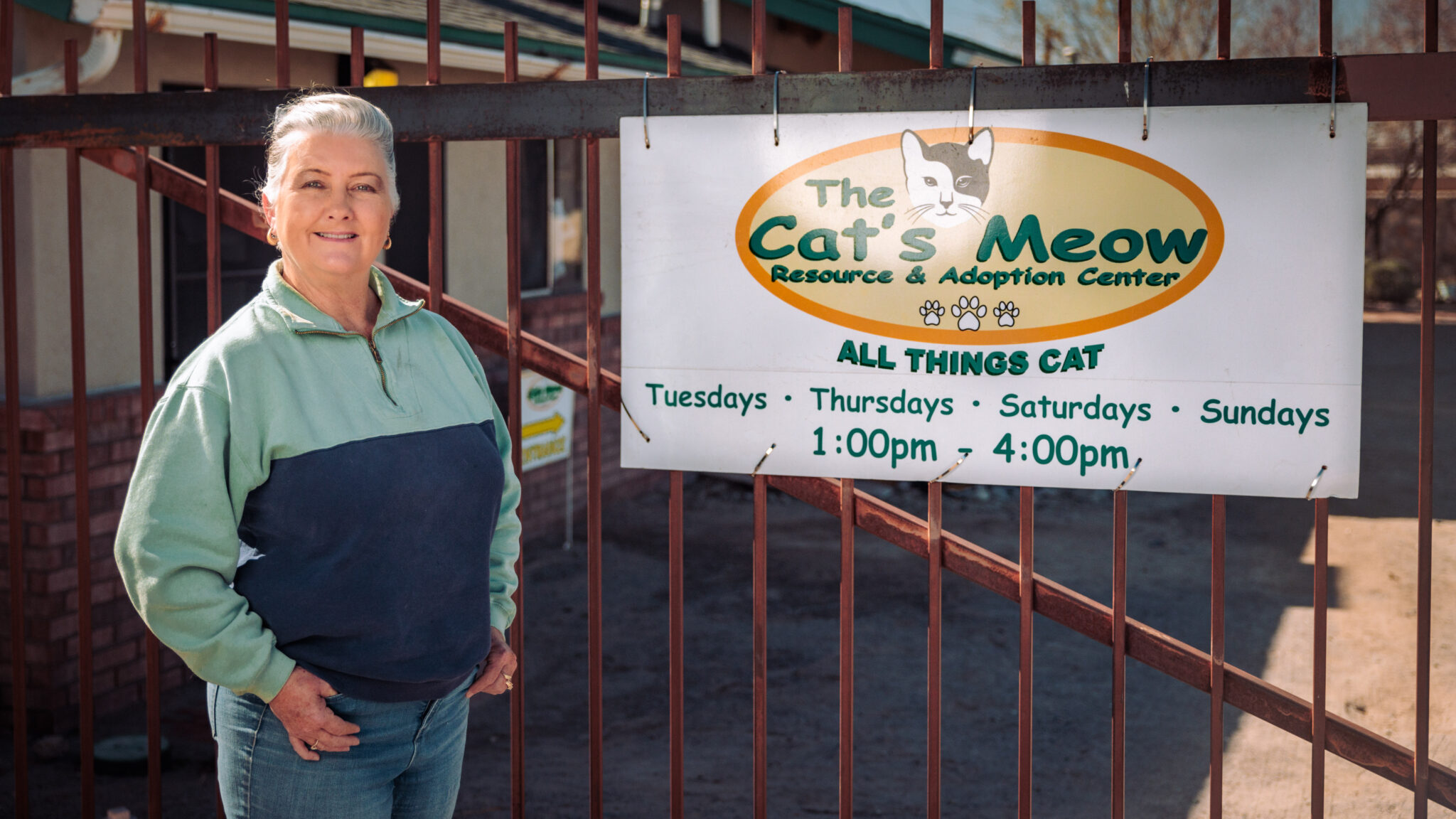
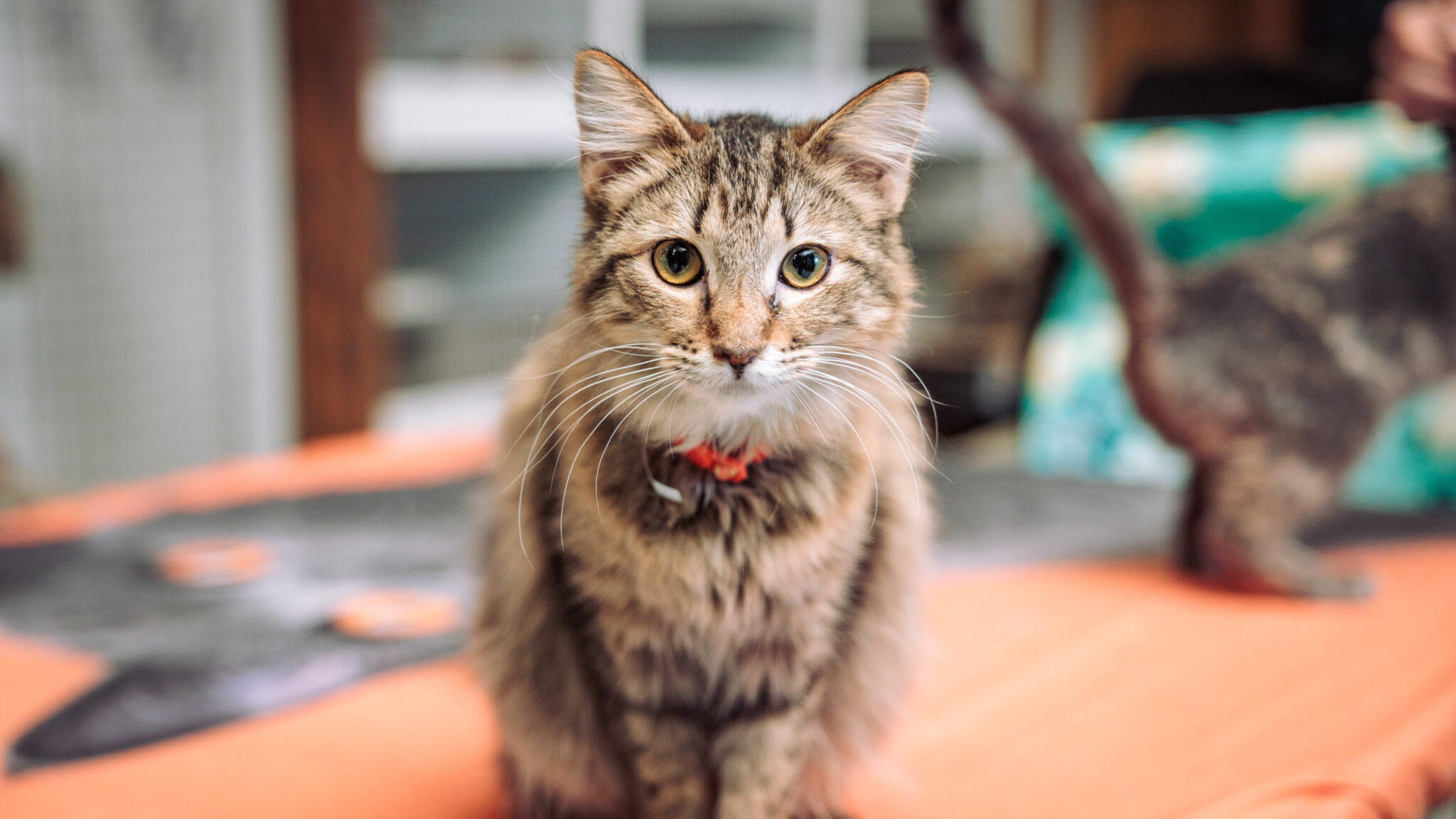
Michelle knew there was a serious need for dedicated resources for cats in the Las Cruces community. Several rescue groups worked with dogs, but displaced cats had nowhere to go except the municipal shelter. With approximately 10,000 animals brought to the shelter annually, there was no guarantee that a cat brought in would come out alive—but there weren’t any options. That is, until 2014, when Michelle, along with a handful of other dedicated cat people, founded Cat’s Meow Adoption Center (CMAC), Las Cruces’ first feline-only adoption center, where she currently serves as a board member, webmaster, and “fill-in-where-needed” person.
Since 2014, CMAC has adopted out about 2,500 cats and sterilized nearly 3,500. Michelle and her husband, Art, did many of the renovations themselves in their spare time on the property that was a former nursery, including sealing the floors and building banks of kitty condo enclosures. A 501c3 organization, CMAC has no paid staff and relies on roughly 25 volunteers to do everything from cat care to adoptions to fundraising.
Michelle is always looking for volunteers, noting that “the time and effort you put in is well worth it when you see the difference you can make in the lives of people and animals.” Find out more about Cat’s Meow Adoption Center at thecatsmeowlascruces.com/.